SRD SASSA for Students (Common Conflicts + Eligibility Notes) — 2026
Primary source: SRD Status Portal (srd.sassa.gov.za)
If you’re a student wondering whether you qualify for the Social Relief of Distress (SRD) grant, this guide provides clear, evidence-based answers. We’ll explain what SASSA officially confirms about student eligibility, address common conflicts students face (NSFAS, bursaries, part-time work), and show you how to navigate the application process safely. All information is sourced exclusively from official SASSA portals verified on 22 January 2026.
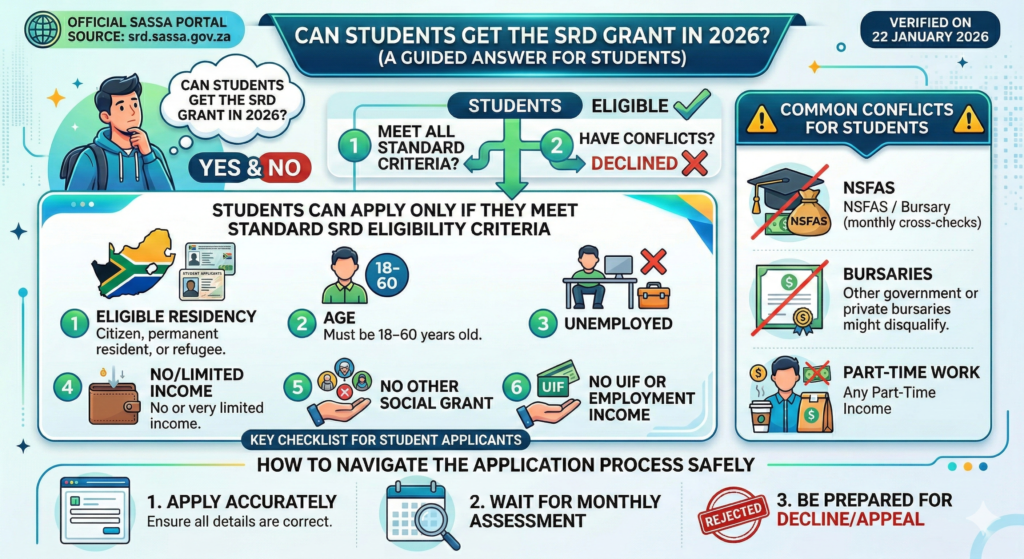
Can students get the SRD grant in 2026?
There is no student-specific SRD rule published on the official SRD portal as of 22 January 2026).
Students can apply only if they meet the standard SRD eligibility criteria:
- ✓ Eligible residency category (South African citizen, permanent resident, or refugee)
- ✓ Age 18–60
- ✓ Unemployed
- ✓ No income or very limited income
- ✓ Not receiving another social grant, UIF, or income from employment
Eligibility is assessed based on your application details. Some applicants may see a decline reason like “Alternative income source identified.”
What this guide covers
- Official SRD eligibility rules as they apply to everyone, including students
- Official status terms students commonly see (Pending, Referred, Declined, Approved)
- Student conflict situations (NSFAS, bursaries, stipends, part-time work) explained within the context of official rules
- How to apply, check status, and appeal using official SASSA portals
- Scam safety and what to avoid
What this guide will NOT claim
We will not publish an income threshold number. The exact income threshold amount is on official SRD pages as of 22 January 2026. Do not trust websites claiming specific amounts like “R624” or “R1,500.”
We will not claim bursaries/NSFAS/stipends “count” or “don’t count” as income. Official SASSA portals do not define whether these specific funding sources are counted as income . We’ll explain what’s officially stated and where the gaps are.
We will not invent rules. If SASSA hasn’t published it on official portals, we’ll state and guide you to contact SASSA directly for clarification.
SRD eligibility checklist (official baseline rules)
Use this as your student-friendly checklist. If you answer “No” to any requirement or “Yes” to any exclusion, you’re likely ineligible.
1) Citizenship / residency
Must be: “South African citizen, permanent resident or refugee”
You must be one of these three categories. Temporary residents, visitors, or undocumented persons don’t qualify.
2) Age
“Must be 18–60 years old”
Most students aged 18–24 will meet this requirement. If you’re under 18 (e.g., matric students aged 16–17), you don’t qualify. If you’re over 60, you don’t qualify for SRD but may qualify for the Older Persons Grant.
3) Employment status
“Must be unemployed”
You cannot have formal employment. SASSA verifies employment status through government databases (SARS, UIF, National Treasury).
What about part-time work?
The official wording doesn’t distinguish between full-time and part-time work—it simply states “unemployed.” If you’re registered as employed (even part-time), you likely don’t qualify. See “Common student conflicts” section below.
4) Income / means test wording (official phrasing)
“Must have no income or very limited income”
You must either have no income at all, or your income must be “very limited.” The official wording does not specify:
- What “very limited” means in Rand amounts
- Whether bursaries, NSFAS allowances, or stipends count as “income”
5) Exclusions (must NOT be receiving)
You must answer “No” to all three of these:
“Must not be receiving another social grant”
If you’re receiving any other SASSA grant (Disability Grant, Older Persons Grant, etc.), you don’t qualify. Note for student parents: If you’re a caregiver receiving Child Support Grant for your children (not as the child recipient yourself), the rules may be different. Contact SASSA to confirm.
“Must not be receiving UIF”
If you’re receiving UIF payments, you don’t qualify. Once UIF ends, you can apply if you meet all other criteria.
“Must not be receiving income from employment”
This overlaps with the “unemployed” requirement. If you’re receiving a salary or wages, you don’t qualify.
Student-specific eligibility (what SASSA does and does not say)
Student rule on SRD portal
Student-specific eligibility:
As of 22 January 2026, we searched official SASSA portals (srd.sassa.gov.za, www.sassa.gov.za) and could not find any explicit rules mentioning:
What that means for students
Being a student is not listed as an automatic “yes” or “no” on the official SRD portal. Your eligibility outcome depends on whether your situation triggers the baseline rules—especially the income-related requirements and exclusions.
In practice:
- • If you’re a full-time student with no employment, no UIF, no other grant, and no income (or very limited income), you may qualify
- • If you’re receiving funding that SASSA’s systems identify as “income” (e.g., through database checks), you may be declined with reason “Alternative income source identified”
- • If you’re working part-time or have a learnership/internship with income, you may be declined based on the “income from employment” exclusion
Because SASSA doesn’t publish specific guidance on student funding sources, the safest approach is to apply and let SASSA assess or contact SASSA first to ask about your specific situation.
Common student conflicts (officially supported points + safe guidance)
UIF conflict
Official rule: “Must not be receiving UIF”
What students should do:
If you’re receiving UIF payments (e.g., after losing a part-time job or vacation work), you do not qualify for SRD under the official exclusion rule. Once your UIF payments end and you meet all other criteria, you can apply.
Other social grant conflict
Official rule: “Must not be receiving another social grant”
What students should do:
If you’re receiving any other SASSA grant (e.g., Disability Grant), you do not qualify for SRD.
Student parents receiving Child Support Grant:
The official exclusion list is “another social grant,” but if you’re a caregiver receiving Child Support Grant for your children (not as the child yourself), this scenario can be complex. Contact SASSA via WhatsApp (082 046 8553), call centre (0800 60 10 11), or email (grantenquiries@sassa.gov.za) to confirm.
Employment income conflict
Official rule: “Must not be receiving income from employment”
What students should do:
If you’re employed (full-time or part-time) and receiving a salary or wages, you do not qualify for SRD.
Common student question: “What about part-time work?”
The official wording does NOT distinguish between full-time and part-time employment. It simply states “must be unemployed” and “must not be receiving income from employment.”
Safe guidance:
- If you have formal part-time employment with a registered employer (paying tax, contributing to UIF), SASSA’s database checks will likely identify this as “income from employment” and you’ll be ineligible
- If you do occasional informal work (e.g., tutoring, selling goods) that doesn’t appear in government employment databases, SASSA’s automated assessment may not detect it—but if flagged for manual review (“Referred” status), you may be asked to explain
“Alternative income source identified” (decline reason)
Official status/decline language: “Alternative income source identified”
This is a common decline reason students see on their status page.
What it means:
SASSA’s assessment identified an alternative income source in their database checks. The specific source is not stated in the decline reason.
Possible triggers:
- Employment income detected in SARS or UIF databases
- UIF payments detected
- Another social grant detected
- Other income source detected through inter-governmental data sharing (possibly including certain types of student funding, but this is not officially confirmed)
What students should NOT assume:
Do not assume this reason means SASSA checked your bank balance, counted your NSFAS allowance, or looked at your bursary. We could not find official documentation stating what specific sources trigger this decline reason.
What to do:
- Review the baseline eligibility criteria above—do you genuinely meet all requirements?
- If you believe you meet all criteria and the decline is incorrect, submit an appeal at srd.sassa.gov.za/appeals
- In your appeal, explain your situation (e.g., “I am a full-time student with no employment, no UIF, and no other grant…”)
- Contact SASSA via WhatsApp (082 046 8553), call centre (0800 60 10 11), or email (grantenquiries@sassa.gov.za) to ask what income source was detected
SRD “means test” and income threshold (what’s known vs unknown)
What is officially stated
“Must have no income or very limited income”
This is the only official income-related requirement published on the SRD portal. It’s vague—no specific Rand amount, no definition of “very limited,” and no clarification on what types of income are counted.
What is NOT officially found
As of 22 January 2026, we could not find official documentation clarifying:
- ✕ No official numeric income threshold amount (e.g., “R624 per month,” “R1,500 per month”)
- ✕ No official clarity on: Gross vs net income, Monthly vs per-period, Household vs individual income, or whether bursaries/stipends/NSFAS are counted as income
The reality for students
Many students receive NSFAS funding, bursaries, or stipends that cover tuition, accommodation, meals, and books. These funds are meant for education, not personal income—but SASSA has not published official guidance on whether they count toward the “no income or very limited income” requirement.
What we know:
- SASSA assesses eligibility by checking government databases
- Some students are approved even though they receive NSFAS or bursaries
- Some students are declined with “Alternative income source identified” even though they believe they have no “income”
What we don’t know:
- Exactly which student funding sources SASSA counts as “income”
- What specific databases SASSA checks to detect student funding
- What the numeric threshold for “very limited income” is
Safe approach for students:
If you receive student funding and are unsure whether you qualify: Contact SASSA before applying via WhatsApp (082 046 8553), call centre (0800 60 10 11), or email (grantenquiries@sassa.gov.za).
Do not trust websites claiming “Bursaries don’t count” or “NSFAS recipients qualify”—these are NOT FOUND (OFFICIAL).
SRD application process (official steps)
Where to apply
“Apply online at srd.sassa.gov.za”
Basic application steps
1. “Enter your ID number”
Use your 13-digit South African ID number from your green barcoded ID book or smart ID card.
2. “Enter your mobile number”
Use your 10-digit South African mobile phone number (e.g., 072 123 4567).
3. “Receive OTP”
SASSA will send a one-time PIN (OTP) to your phone via SMS. This usually arrives within seconds to a few minutes.
4. “Complete application”
Enter the OTP to verify your phone number, then follow the on-screen prompts to complete your application.
How eligibility is assessed (official wording)
“Eligibility is assessed based on your application details”
SASSA verifies your eligibility by checking government databases:
- Home Affairs
- SARS
- UIF
- National Treasury
- Social Development
This assessment is mostly automated. If the system can’t verify something, your application may be marked “Referred” for manual review.
How students check SRD status (official)
Where to check
“Check your status at srd.sassa.gov.za”
After applying, check your status regularly at srd.sassa.gov.za.
What to prepare
Enter the same ID number and mobile phone number you used during application. If you’ve changed your phone number since applying, update it at srd.sassa.gov.za/sc19/contact before checking status.
Status terms students commonly see (official definitions)
Pending
“Pending: under review”
Your application is being reviewed by SASSA’s automated system. This is normal processing. Most applications progress from Pending to Approved or Declined within 7–14 days.
Referred
“Referred: further verification needed”
Your application needs additional verification beyond standard automated checks. SASSA may contact you for more information. This status can take longer to resolve (2–3 weeks or more).
What students should do: Ensure your contact details are correct at srd.sassa.gov.za/sc19/contact. If it stays “Referred” for more than 3 weeks, contact SASSA.
Declined
“Declined: not approved”
Your application was assessed and you don’t meet eligibility criteria. A specific decline reason will be shown (e.g., “Alternative income source identified,” “Receiving UIF,” “Receiving another grant”).
Approved
“Approved (No payment date): payment date not yet assigned”
Your application is approved but SASSA hasn’t assigned a payment date yet. This is normal—SASSA processes payments in batches. Check your status every few days. If no payment date appears after 7 days, contact SASSA.
“Approved” means your application is approved and a payment date is shown on your status page.
What to do if you’re declined (official fix paths)
Appeal / reconsideration
“Submit an appeal via the official appeals portal”
If you believe your decline is incorrect, submit an appeal at srd.sassa.gov.za/appeals.
- ✓ Requirements: ID and phone number
- ✕ Deadline:
Without an official deadline, appeal as soon as possible after receiving a decline.
How to appeal:
- Go to srd.sassa.gov.za/appeals
- Enter your ID number and phone number
- Select the month/period you’re appealing
- Explain why you believe the decline is incorrect (e.g., “I am a full-time student with no employment…”)
- Submit the appeal
- Check your appeal outcome by returning to the appeals portal
Update details if they changed
If your phone number, address, or banking details changed since you applied, update them:
Contact update:
srd.sassa.gov.za/sc19/contact
Banking details update:
srd.sassa.gov.za/sc19/banking-details-update
Use official contact channels
If you need clarification on your decline reason or eligibility, contact SASSA directly:
WhatsApp: 082 046 8553
Call centre: 0800 60 10 11
Email: grantenquiries@sassa.gov.za
⚠️ Scam safety
What you should never share
“Never share your OTP, PIN, or banking details with anyone.”
OTP (one-time PIN):
The OTP sent to your phone is for your use only. SASSA will never ask for it via phone, SMS, WhatsApp, or email.
PIN:
Your payment PIN for Post Office or retail collection is private.
Banking details:
Do not share account numbers, card numbers, CVVs, or online banking passwords.
Safe domains to trust
srd.sassa.gov.za
sassa.gov.za
These are the only official SASSA domains. If a website doesn’t end in these exact domains, close it immediately.
Common student scams:
- Websites offering “SRD for students” or “NSFAS + SRD guaranteed approval”
- People offering to “help students apply” for a fee—SASSA services are free
- SMS or WhatsApp messages asking for your OTP or banking details
Myths to avoid
Many unofficial websites make claims about SRD for students that are not official. Don’t trust these:
“Students automatically qualify”
NOT FOUND (OFFICIAL)
There is no automatic eligibility for students. You must meet all baseline SRD criteria.
“NSFAS recipients qualify”
NOT FOUND (OFFICIAL)
SASSA has not published official guidance confirming NSFAS recipients automatically qualify or are automatically excluded.
“Bursary/stipend doesn’t count as income”
NOT FOUND (OFFICIAL)
SASSA has not published official guidance on whether bursaries or stipends count toward the “no income or very limited income” requirement.
“Income threshold is R___”
NOT FOUND (OFFICIAL)
No specific Rand amount is published on official SASSA portals.
“Guaranteed approval”
NOT FOUND (OFFICIAL)
No action guarantees approval. Approval depends on SASSA’s assessment of your eligibility.
FAQs
Can students get SRD in 2026?
Students can apply if they meet all baseline SRD criteria: eligible residency category, age 18–60, unemployed, no income or very limited income, and not receiving another grant/UIF/employment income. There is no student-specific rule , so eligibility depends on whether you meet these standard requirements.
Can full-time students get SRD?
Being a full-time student is not listed as a disqualifier . You can apply if you meet all baseline criteria. However, if you receive funding that SASSA identifies as “income,” you may be declined. Contact SASSA to confirm before applying if you’re unsure.
Can NSFAS recipients get SRD?
. SASSA has not published official guidance on whether NSFAS recipients qualify or are excluded. Some NSFAS recipients are approved, others declined with “Alternative income source identified.” Contact SASSA via WhatsApp (082 046 8553), call centre (0800 60 10 11), or email (grantenquiries@sassa.gov.za) to ask about your specific situation.
Can students with bursaries get SRD?
SASSA has not published official guidance on whether bursaries count as “income.” If you receive a bursary and are unsure, contact SASSA before applying to ask about your eligibility.
Can students with stipends get SRD?
. SASSA has not published official guidance on whether stipends count as “income.” Contact SASSA to confirm before applying.
Can students working part-time get SRD?
The official requirement states “Must be unemployed” and “Must not be receiving income from employment.” The wording does NOT distinguish between full-time and part-time work . If you have formal part-time employment, you likely don’t qualify.
Can students receiving child support grant get SRD?
The official exclusion states “Must not be receiving another social grant.” If you’re a caregiver receiving Child Support Grant for your children (not as the child yourself), contact SASSA to confirm whether this affects your eligibility, as this scenario can be complex.
What happens if a student receives UIF?
You don’t qualify. The official requirement states “Must not be receiving UIF.” Once UIF payments end, you can apply if you meet all other criteria.
What happens if a student receives another social grant?
You don’t qualify. The official requirement states “Must not be receiving another social grant.”
What happens if a student receives employment income?
You don’t qualify. The official requirement states “Must not be receiving income from employment.”
What does “Alternative income source identified” mean?
This decline reason indicates SASSA detected an income source in their database checks. The specific source isn’t stated. For students, this could relate to employment, UIF, grants, or other income sources. If you believe it’s incorrect, appeal at srd.sassa.gov.za/appeals.
How do students apply for SRD?
Apply online at srd.sassa.gov.za. Enter your ID number, mobile number, receive OTP, and complete the application.
Where do students check SRD status?
Check at srd.sassa.gov.za using the same ID number and mobile number you used to apply.
What does “Pending” mean?
“Pending: under review” means your application is being reviewed by SASSA’s automated system. This is normal processing.
What does “Referred” mean?
“Referred: further verification needed” means your application needs additional verification. SASSA may contact you. This can take 2–3 weeks or longer.
What does “Approved (No payment date)” mean?
“Approved (No payment date): payment date not yet assigned” means you’re approved but SASSA hasn’t assigned a payment date yet. This is normal—payments are processed in batches. Check every few days.
What if I’m declined—how do I appeal?
Submit an appeal at srd.sassa.gov.za/appeals. You need your ID number and phone number. Explain why you believe the decline is incorrect.
How do students update their SRD contact details?
Go to srd.sassa.gov.za/sc19/contact to update your phone number or address.
How do students update their SRD banking details?
Go to srd.sassa.gov.za/sc19/banking-details-update to update your bank account or payment method.
What is the official SRD WhatsApp number?
082 046 8553
This is the only official SASSA WhatsApp number for SRD help.
What is the SRD call centre number?
0800 60 10 11
Toll-free helpline, Monday to Friday, 8 AM to 4 PM.
What is the SRD email address?
grantenquiries@sassa.gov.za
For written enquiries. Response time typically 2–5 business days.
What details should I never share?
Never share your OTP, PIN, or banking details with anyone. SASSA will never ask for these via phone, SMS, WhatsApp, or email.
What are the safe SRD domains?
srd.sassa.gov.za and sassa.gov.za are the only official SASSA domains. Close any other website immediately.